How to Choose the Right Papad Making Machine for Your Business in India
Adway Sawant · Sep 4, 2026
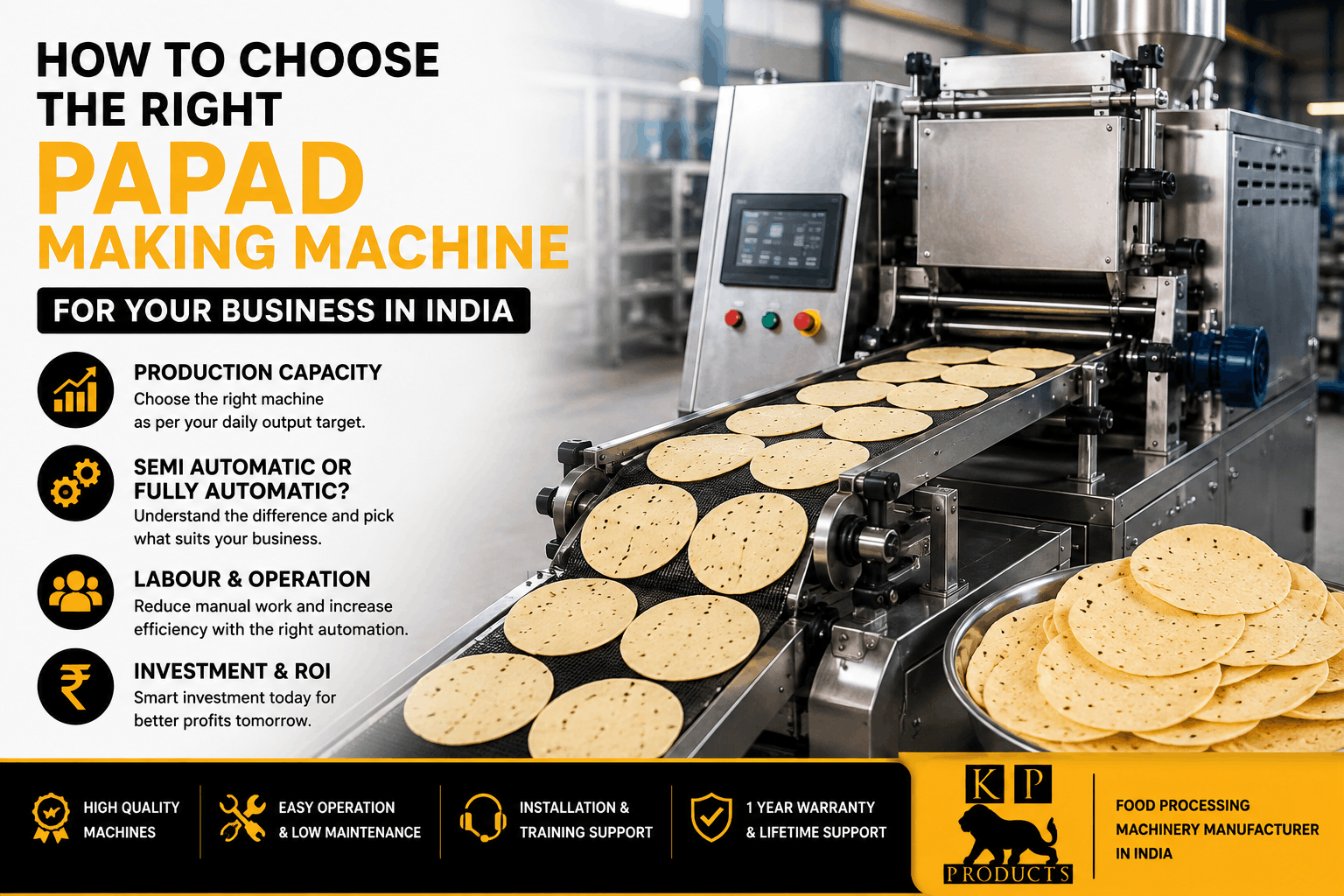
tarting or expanding a papad manufacturing business requires the right production equipment. The choice of papad making machine can affect production capacity, labour requirements, consistency, operating efficiency and future scalability.
With different types of papad machines available for small, medium and large production units, it is important to select a machine according to your actual business requirements rather than choosing only on the basis of price.
KP Products manufactures food-processing machinery for papad manufacturers and food businesses across India, including semi-automatic and fully automatic papad machines as well as Khichiya papad machines.
1. Understand Your Required Production Capacity
The first question to ask is:
How much papad do you need to produce every day?
A small business may require a lower-capacity machine, while a larger commercial manufacturing unit may need continuous production with higher output.
KP Products currently lists:
- Semi Automatic Papad Making Machine: 150–200 kg/day
- Fully Automatic Papad Making Machine: 500–800 kg/day
- Khichiya Papad Making Machine: 60–90 kg/hr
Your production target should be based on your expected orders, available labour, working hours and planned future expansion.
2. Semi Automatic or Fully Automatic?
One of the most important decisions is choosing the right level of automation.
Semi Automatic Papad Machine
A semi-automatic machine can be suitable for growing businesses that want to improve production while keeping investment and process complexity relatively moderate.
KP Products describes its semi-automatic papad line as a rolling and cutting system designed for growing units, with a listed capacity of 150–200 kg/day.
This option may be considered by:
- Small and medium production units
- New manufacturers scaling up production
- Businesses with available operators
- Units that do not yet require a fully automated production line
Fully Automatic Papad Machine
A fully automatic machine is more suitable for businesses that require higher production capacity and greater automation.
KP Products lists its fully automatic papad line at 500–800 kg/day and describes it as a PLC-controlled system covering the production process from dough to finished papad with minimal operator intervention.
This type of machine can be considered by:
- Large papad manufacturers
- High-volume commercial units
- Businesses supplying distributors or multiple markets
- Manufacturers planning long-term production expansion
3. Consider Labour Requirements
Labour availability is another important factor.
When comparing machines, don't look only at the purchase cost. Consider how much manual work is required for:
- Dough preparation
- Rolling
- Cutting
- Handling
- Drying
- Packaging
A more automated production setup can reduce the amount of manual intervention required at certain stages. The right choice depends on your production process and operating model.
4. Check Machine Capacity Carefully
Machine capacity is one of the most important specifications to compare.
However, capacity should not be viewed in isolation.
Ask the manufacturer:
- What is the expected production output?
- What operating conditions are assumed?
- How many working hours are recommended?
- How many operators are required?
- What type of raw material is suitable?
- What machine configuration is included?
This helps you compare machines more accurately before investing.
5. Think About Your Available Space
Before ordering a machine, measure the available production area.
Consider space for:
- Machine installation
- Operator movement
- Raw material storage
- Dough preparation
- Product handling
- Drying
- Packaging
- Maintenance access
A machine that fits the production target but does not fit comfortably into the available workspace can create operational problems later.
6. Don't Choose a Machine Only by Price
Price is important, but the cheapest machine is not necessarily the most suitable machine.
Instead, compare the complete value:
Machine cost + production capacity + labour + maintenance + after-sales support + spare parts + scalability
For example, a lower-priced machine may suit a small production unit, while a higher-capacity automated machine may make more sense for a business expecting significantly higher order volumes.
KP Products lists machines across several food-processing categories and provides quotation-based purchasing through its website.
7. Check After-Sales Service and Installation
Machine installation and support are especially important for first-time machinery buyers.
Before purchasing, ask whether the manufacturer provides:
- Installation support
- Operator training
- Technical assistance
- Spare parts
- Warranty
- Maintenance support
KP Products states that it provides free installation, technical support, a one-year warranty and lifetime spares support, along with PAN-India delivery.
8. Choose a Manufacturer Who Understands Your Business
A machine manufacturer should understand more than just the machine itself.
A good discussion with the supplier should cover:
- Your target production
- Product type
- Available space
- Labour availability
- Power requirements
- Expansion plans
- Budget
- Expected applications
This makes it easier to select the appropriate machine configuration instead of buying a machine that is either too small or unnecessarily large.